

A-share three major indices open lower: investment logic and opportunities amid market divergence
Keywords: A-share indices, sector rotation, margin trading, investment strategy
I. Introduction
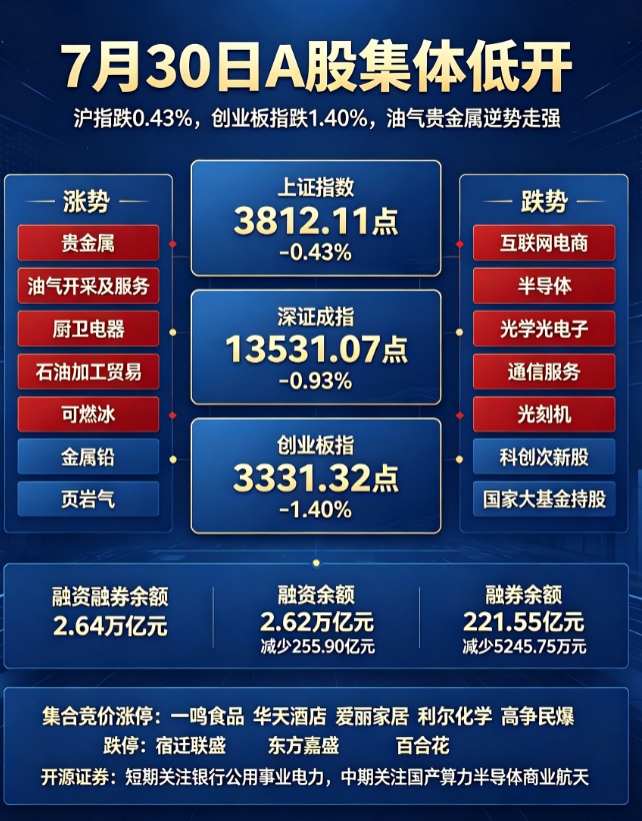
On July 30, 2026, the A-share market opened lower, with all three major indices declining. The Shanghai Composite Index opened at 3812.11 points, down 0.43%; the Shenzhen Component Index opened at 13531.07 points, down 0.93%; and the ChiNext Index opened at 3331.32 points, down 1.40%. This opening performance attracted widespread market attention, and investors raised many questions about the current market trend. The low opening reflects both the uncertainty of the global macro economic environment and the deep adjustment and structural divergence undergoing in the domestic capital market.
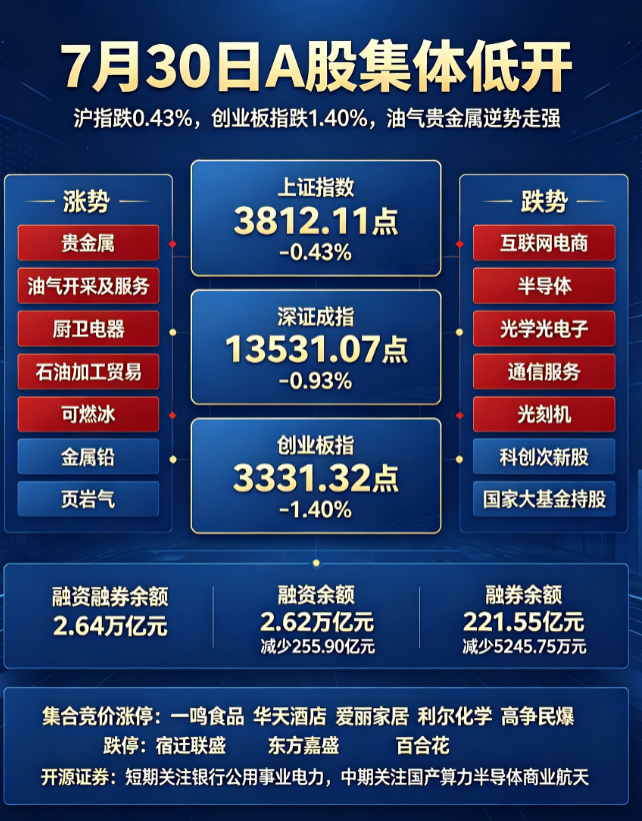
As shown in the figure above, all three indices opened lower, with the ChiNext Index experiencing the most significant decline, nearly 1.4%, indicating greater pressure on growth sectors. In this market environment, an in-depth analysis of sector performance, capital flows, and institutional views is valuable for grasping short-term opportunities and medium to long-term layouts.
II. Background and sentiment analysis of the lower opening
2.1 Macro environment and market sentiment
The lower opening of the A-share market is not an isolated phenomenon but the result of multiple factors. From a global perspective, recent fluctuations in international commodity prices and escalating geopolitical risks have weighed on risk assets. Domestically, the uneven pace of economic recovery, expectations of industrial policy adjustments, and subtle changes in the liquidity environment together form the basic backdrop of the current market operation.
From a sentiment perspective, investors' caution prevails. A lower opening often reflects capital's risk-averse choices when faced with uncertainty. Notably, the ChiNext Index fell the most, indicating heightened investor concern about high-valuation growth sectors, closely related to their earlier significant gains and increased pressure to deliver earnings.
2.2 Deep logic behind index performance
The Shanghai Composite Index was relatively resilient, falling only 0.43%, due to the higher proportion of defensive sectors such as financials and utilities among its constituents. The larger declines of the Shenzhen Component Index and ChiNext Index reflect more pronounced adjustment pressure on small and medium-cap stocks and tech growth stocks. This divergence among indices actually reveals a process of style switching and structural revaluation in the market.
III. Capital logic behind sector divergence
3.1 Leading sectors: Resources and defense in parallel
On the market, leading sectors showed a distinct resource orientation. The precious metals sector rose the most, closely linked to rising global risk aversion and gold prices staying high. The oil and gas exploration and production, and petroleum processing and trading sectors also performed strongly, benefiting from resilient international oil prices amid supply disruptions and the market's repricing of energy security.
Additionally, the kitchen and bathroom appliances sector rose, reflecting structural opportunities under the expectation of consumption recovery. The common characteristics of these leading sectors are: either defensive (e.g., precious metals), in a cyclical upturn (e.g., oil and gas), or driven by both policy and consumption (e.g., kitchen and bathroom appliances). This combination indicates that capital, as risk appetite declines, is converging on areas with higher certainty.
3.2 Lagging sectors: Technology and growth under pressure
In stark contrast, sectors such as internet e-commerce, semiconductors, optical optoelectronics, and communication services fell the most. These sectors share a common label: tech growth. Against the backdrop of tightening liquidity expectations and downward valuation centers, tech sectors that previously enjoyed high premiums face valuation correction pressure.
From the concept sector perspective, themes such as lithography machines, tech IPO stocks, and national big fund holdings experienced notable declines, further confirming the market's need to cool overheated tech sectors. However, such adjustments are not necessarily bad; they provide opportunities for bubble clearing and valuation returning to reasonable ranges.
3.3 Concept sectors: Energy and resource themes active
Among concept sectors, themes such as combustible ice, lead metal, and shale gas rose the most. The activity of these concepts is closely related to changes in the global energy landscape and the rising strategic value of mineral resources. It is noteworthy that these concepts are not purely speculative; they often have clear industrial logic support, including technological progress, reserve development, and policy support.
IV. Market signals from margin trading data
4.1 Decline in margin balance: Leveraged funds turn cautious
As of July 29, the balance of margin trading in Shanghai and Shenzhen stock markets stood at 2.64 trillion yuan. Among them, the margin balance was 2.62 trillion yuan, down 25.590 billion yuan from the previous trading day. This decline is relatively significant, reflecting the cautious attitude of leveraged funds in the current market environment.
A decline in the margin balance usually has two interpretations: first, investors actively reduce leverage to avoid market risk; second, forced liquidation. Combined with the current lower market opening, the likelihood of active deleveraging is higher, as the market had already experienced some adjustment, and investor risk appetite has naturally decreased.
4.2 Slight decline in short balance: Limited short-selling momentum
Compared with the sharp decline in margin balance, the short balance was 22.155 billion yuan, down 52.4575 million yuan from the previous trading day, a small drop. This indicates that short-selling forces have not significantly increased, and there is no systematic bearish sentiment in the market. The differentiated changes in margin and short balances suggest that the market is more engaged in structural adjustments of existing positions rather than a trend-wise bearish or bullish stance.
4.3 Implications of capital behavior for the future
The combination of a declining margin balance and a slightly declining short balance often signals that the market may be approaching a short-term bottom. Leveraged funds are usually a barometer of market sentiment, and their sharp decline implies that the most pessimistic short-term expectations may have been released. Historically, similar situations have often led to a rebound after overselling.
V. Investment insights from individual stock battles
5.1 Characteristics of stocks hitting the daily limit up
During the call auction, stocks such as Yiming Food, Huatian Hotel, Aili Home, Lier Chemical, and Gaozheng Minbao hit the daily limit up. These stocks are distributed across multiple industries including food, hotels, home furnishings, chemicals, and explosives, showing clear dispersion. Notably, most of these stocks are small and medium-cap companies with strong industry characteristics or thematic catalysts.
For example, Yiming Food belongs to the food consumption sector and gained capital favor amid the current consumption recovery expectation; Huatian Hotel benefited from the recovery of the tourism and travel industry; Gaozheng Minbao is associated with rising infrastructure construction demand. The common features of these limit-up stocks are: clear expectations of fundamental improvement, relatively reasonable valuations, and a degree of industry independence.
5.2 Risk warnings behind stocks hitting the daily limit down
Stocks such as Suqian Liansheng, Dongfang Jiasheng, and Baihehua hit the daily limit down. Among the limit-down stocks, Dongfang Jiasheng is a supply chain service company, and Baihehua is a chemical company. Their limit-downs may be related to company fundamental changes, industry policy adjustments, or resonance of market sentiment.
Investors should note that amid overall sector divergence, individual stock divergence is even more intense. The coexistence of limit-up and limit-down stocks reflects both structural opportunities and a risk pattern of "ice and fire."
VI. Open Source Securities' strategy framework and focus directions
6.1 Short-term allocation: Return to value defense
Open Source Securities analysis points out that in the short term, attention should be paid to allocation repair opportunities brought by style return. Specifically, sectors such as banks, public utilities, and power are worth focusing on. These sectors have characteristics such as low valuation, high dividends, and stable earnings, making them preferred targets for capital in the defensive phase. Especially when the market opens lower and sentiment is low, these sectors can provide a safety cushion.
In addition, low-position industries that have shown signs of profit improvement, such as non-ferrous metals, coal, and basic chemicals, are also worth attention. These industries are at the early stage of a bottom recovery, and with the strengthening of economic recovery expectations, profit turning points may appear first.
6.2 Medium-term layout: Technology and growth main lines
From a medium-term perspective, Open Source Securities suggests focusing on domestic computing power, semiconductors, and other AI hardware chain segments. Although AI-related tech sectors have recently adjusted, the industry trend has not changed; logic such as rapid growth in computing power demand and continuous progress in domestic substitution remains solid. At the same time, structural opportunities also exist in technology spillover directions such as power equipment, energy metals, and liquid cooling.
Additionally, new directions with industrial trends such as commercial aerospace and military industry deserve key attention. These fields have characteristics such as policy certainty, high technical barriers, and rigid demand, enabling them to withstand economic cycle fluctuations.
6.3 Comprehensive considerations of investment strategy
Open Source Securities' strategy framework essentially provides a combination idea of "short-term defense + medium-term growth." In the short term, use the defensive attributes of sectors such as banks and public utilities to reduce portfolio volatility; in the medium term, capture excess returns from industrial trends by laying out directions such as AI and commercial aerospace. This balanced offensive and defensive strategy has strong reference value in the current market environment.
VII. Conclusion
The lower opening of A-share three major indices on July 30, 2026, is the result of multiple factors intertwined. The divergent pattern on the market, with resource and defense sectors leading while tech growth sectors lagging, reveals that the market is undergoing deep structural adjustment. Margin trading data shows leveraged funds turning cautious, but short-selling momentum has not significantly increased. The coexistence of limit-up and limit-down stocks reflects the status quo of both structural opportunities and potential risks.
Looking ahead, the short-term market may continue to oscillate. Investors should remain rational and avoid chasing gains and cutting losses. In terms of allocation, refer to Open Source Securities' suggestion to adopt a flexible strategy of "short-term defense + medium-term growth," paying attention to the defensive value of low-valuation sectors such as banks and public utilities, while actively laying out areas with medium to long-term growth momentum such as AI, semiconductors, and commercial aerospace.
In the current market environment, patience and discipline are key to investment success. Only by deeply understanding market logic and grasping industrial trends can one find certainty amid volatility and seize opportunities amid divergence.